Content Optimization
Content audit in ClinGEO: site structure, text quality, authoritative links, and improvement recommendations.
For writing new clinic articles, start with the Content Hub user guide. It covers setup, blog checks, briefs, review, and WordPress publishing. Content audits assess existing pages; Content Hub is the writing and publishing workflow.
Content Optimization
The "Content Optimization" section (/home/content-optimization) analyzes the quality and completeness of content on your clinic's website.
AI systems are trained on high-quality content. If your site has structured service pages, doctor profiles, a blog, and FAQ sections — AI is far more likely to include it in recommendations.
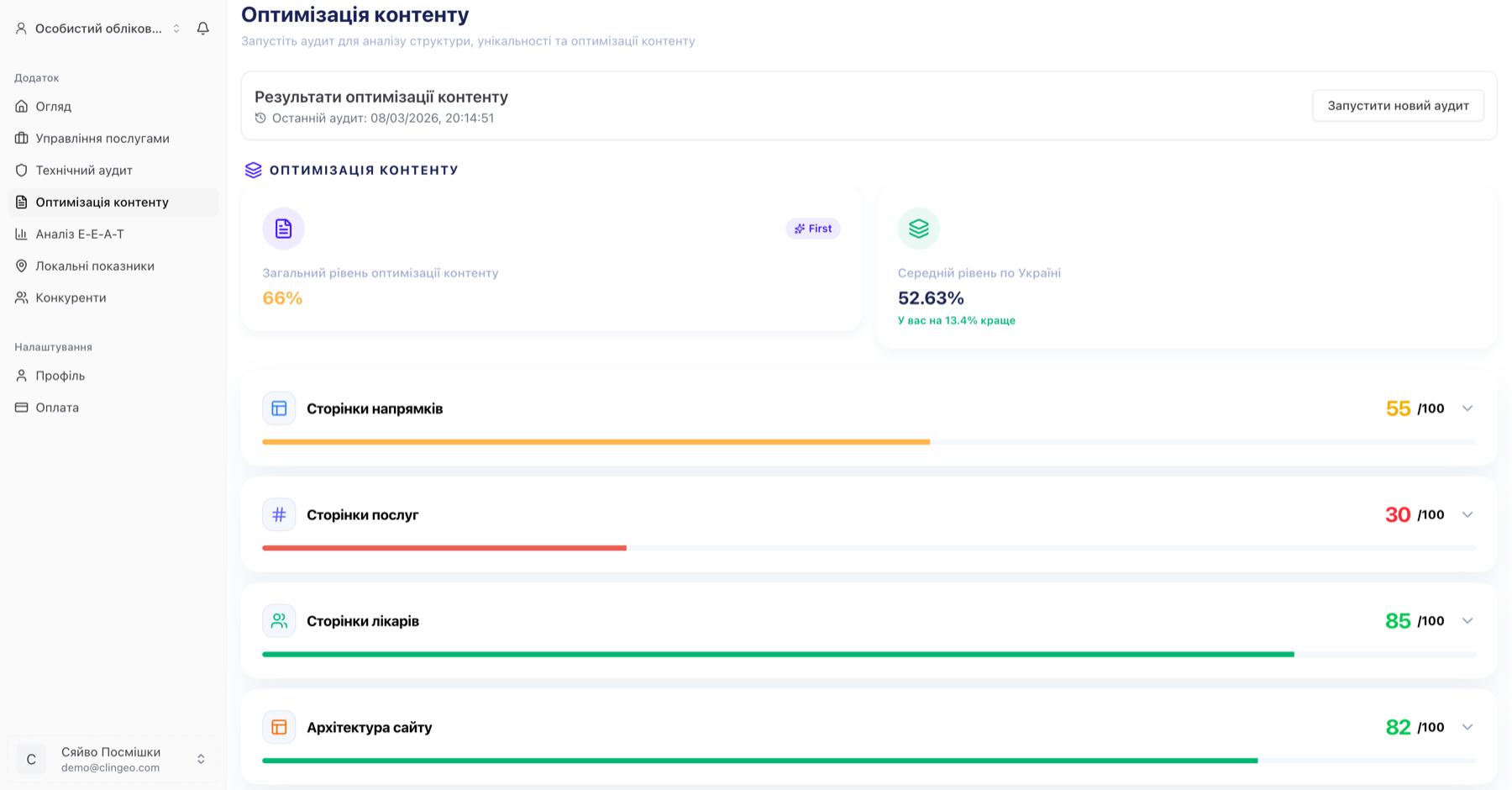
Overall content audit score
At the top of the page is the overall score from 0 to 100.
Alongside it are partial scores for each audit component:
- Site structure — presence of key page types
- Text quality — uniqueness and "wateriness"
- Authority — external links, contact information, FAQ
What the content audit analyzes
Site structure
The audit checks for the presence of these page types:
| Page type | Why it matters for AI |
|---|---|
| Specialty pages | AI determines clinic specialization from service categories |
| Service pages | Details on specific procedures — the foundation for AI recommendations |
| Doctor pages | Doctor profiles with credentials signal trustworthiness to AI |
| Blog | Regularly updated content boosts site authority |
What is checked:
- Presence of photos, biographies, and experience in doctor profiles
- Number of blog articles and publication frequency
- Average article length
- Internal links and "orphan" pages (pages with no incoming links)
Text quality
| Metric | What it means |
|---|---|
| Uniqueness (%) | Percentage of original content. 80%+ is good |
| Wateriness (%) | Share of "empty" phrases with no substance. Below 20% is good |
"Watery" texts are generic phrases like "We're delighted to offer you the best service", "Our clinic is the industry leader", etc. AI prefers specific, factual content.
Content authority
| Metric | What is analyzed |
|---|---|
| Links to authoritative sources | Number of links to WHO, MOH, PubMed, scientific journals |
| Contact information | Presence of correct address and phone number |
| Clickable phone | Whether tel: links are clickable on mobile |
| FAQ | Number of questions and length of answers |
Detailed results
Clicking any component shows expanded information:
Structure results
- Number of pages found for each type
- Site architecture depth chart
- List of "orphan pages" with no internal links
Text quality results
- Uniqueness score broken down by page type
- Top phrases that increase "wateriness"
Authority results
- List of found authoritative external links
- Contact information status (address, phone)
- FAQ statistics (count, average answer length)
Recommendations
At the bottom of the page is a list of recommendations with priorities:
| Priority | Meaning |
|---|---|
| 🔴 Critical | Fix as soon as possible — significant impact on AI visibility |
| 🟡 Warning | Will improve metrics with a few hours of work |
| 🔵 Info | Useful to know, minor impact |
Running the audit
- Go to Content Optimization (
/home/content-optimization) - Click "Run audit"
- The audit analyzes up to 15 key pages — usually takes 2–5 minutes
How it works: ClinGEO first discovers pages through the sitemap and homepage, then sorts them by type (services, doctors, blog) and loads them for analysis.
Tips for improving content
Fastest impact:
- Add FAQ to service pages — at least 5 questions with detailed answers (150+ characters each)
- Add links to WHO or MOH — at least 1–2 links to authoritative medical sources in each blog article
- Make the phone number clickable —
<a href="tel:+1xxxxxxxxxx">
Medium-term:
- Describe each service in detail — at least 500 words, covering the procedure, indications, contraindications, preparation, and recovery
- Add complete doctor profiles — photo, education, years of experience, specialty, certifications
- Blog regularly — at least 2 articles per month with links to scientific sources