Competitor Analysis
How ClinGEO identifies your clinic's AI competitors and what the Competitors section shows.
Competitor Analysis
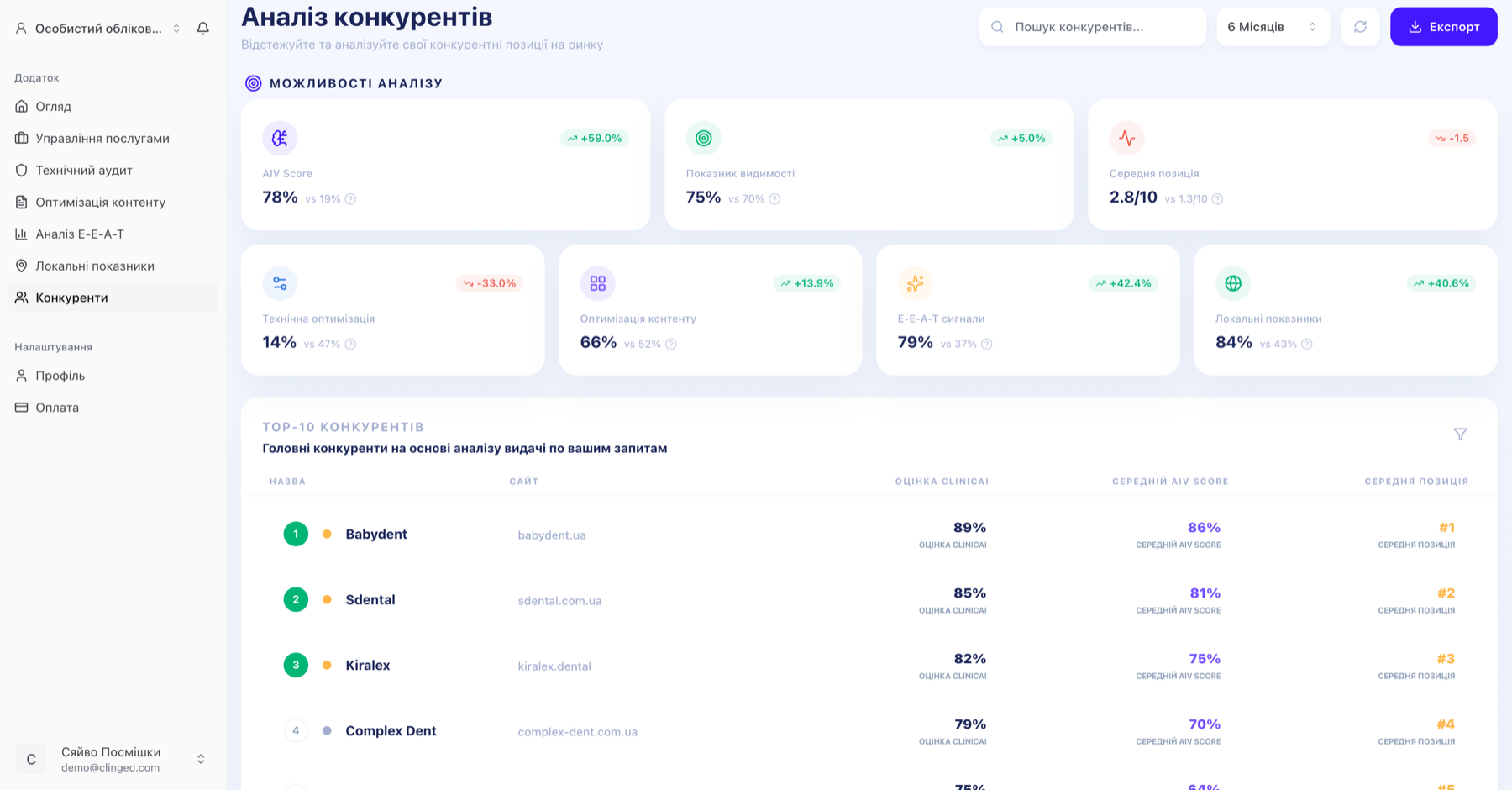
The "Competitors" section (/home/competitors) shows which medical facilities AI systems recommend alongside your clinic or instead of it.
How are competitors identified?
ClinGEO automatically identifies competitors based on AI scans:
- With each scan, AI returns a list of clinics for the given service and city
- Domains that appear in AI responses are recorded as competitors
- The more often a domain appears in responses — the "stronger" the competitor
- The competitor list updates automatically after each new scan cycle
You see exactly the competitors that AI systems consider best — not just those you already know. This is an important distinction from traditional SEO analysis.
Section overview
Competitors table
For each competitor:
| Field | Description |
|---|---|
| Name / Domain | Competitor name and web address |
| AIV | Competitor's AIV Score / AI Visibility Score (0–100) |
| Appearance frequency | In how many AI responses the competitor appears |
| Average position | Competitor's average place in AI responses |
| Trend | AIV dynamics over the last week |
Competitors are sorted by AIV by default — strongest at the top.
Competitor AIV
AIV Score (AI Visibility Score) is calculated for each competitor the same way as for your clinic:
- Based on frequency of appearance in AI responses, average position, and total result count
- Shown on a 0–100 scale
- Shows the competitor's relative strength in the AI landscape
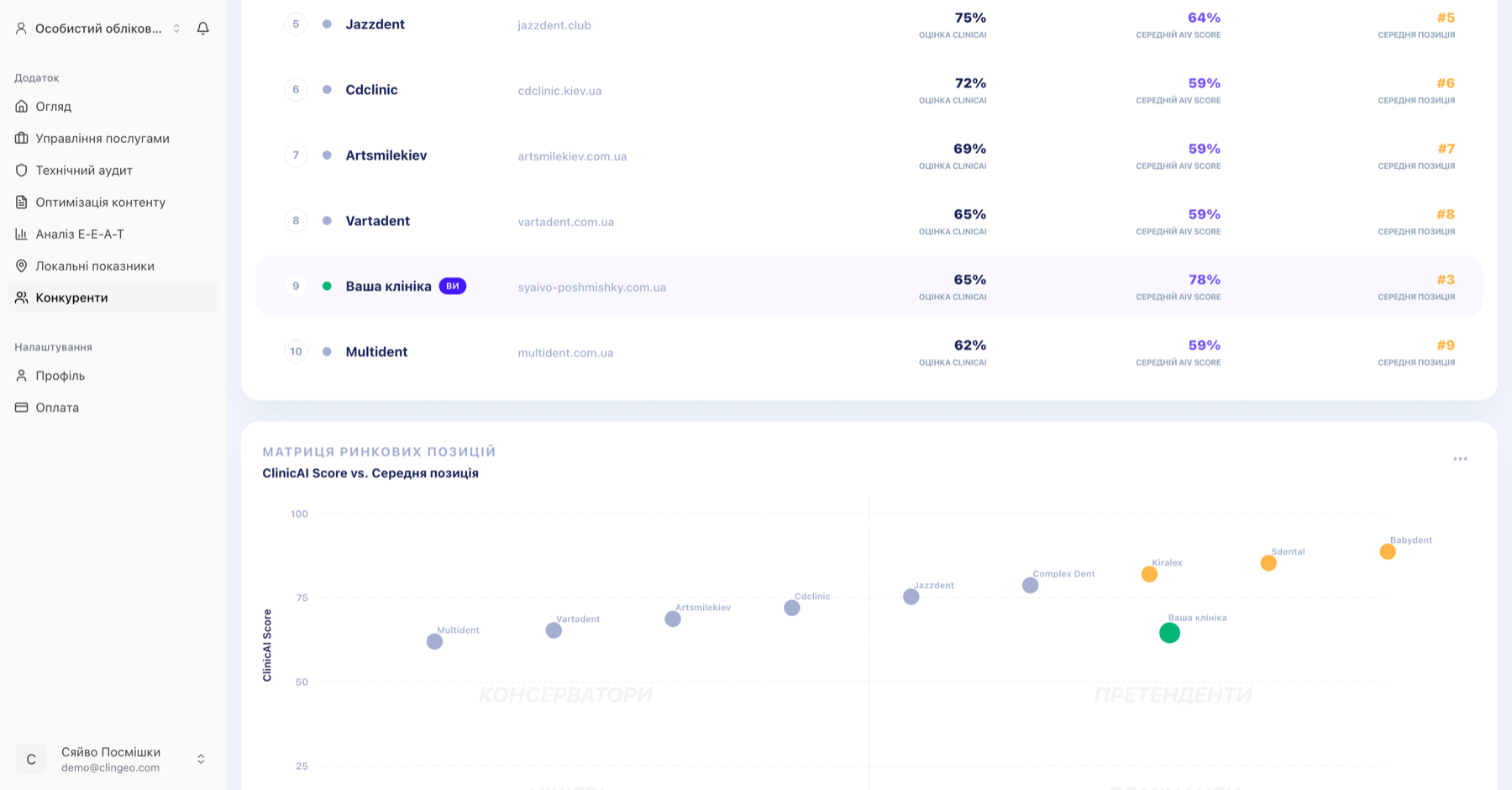
Market position matrix
A scatter chart of ClinicAI Score vs Average Position shows where your clinic stands relative to competitors. Quadrants: LEADERS, DOMINATORS, CHALLENGERS, CONSERVATIVES.
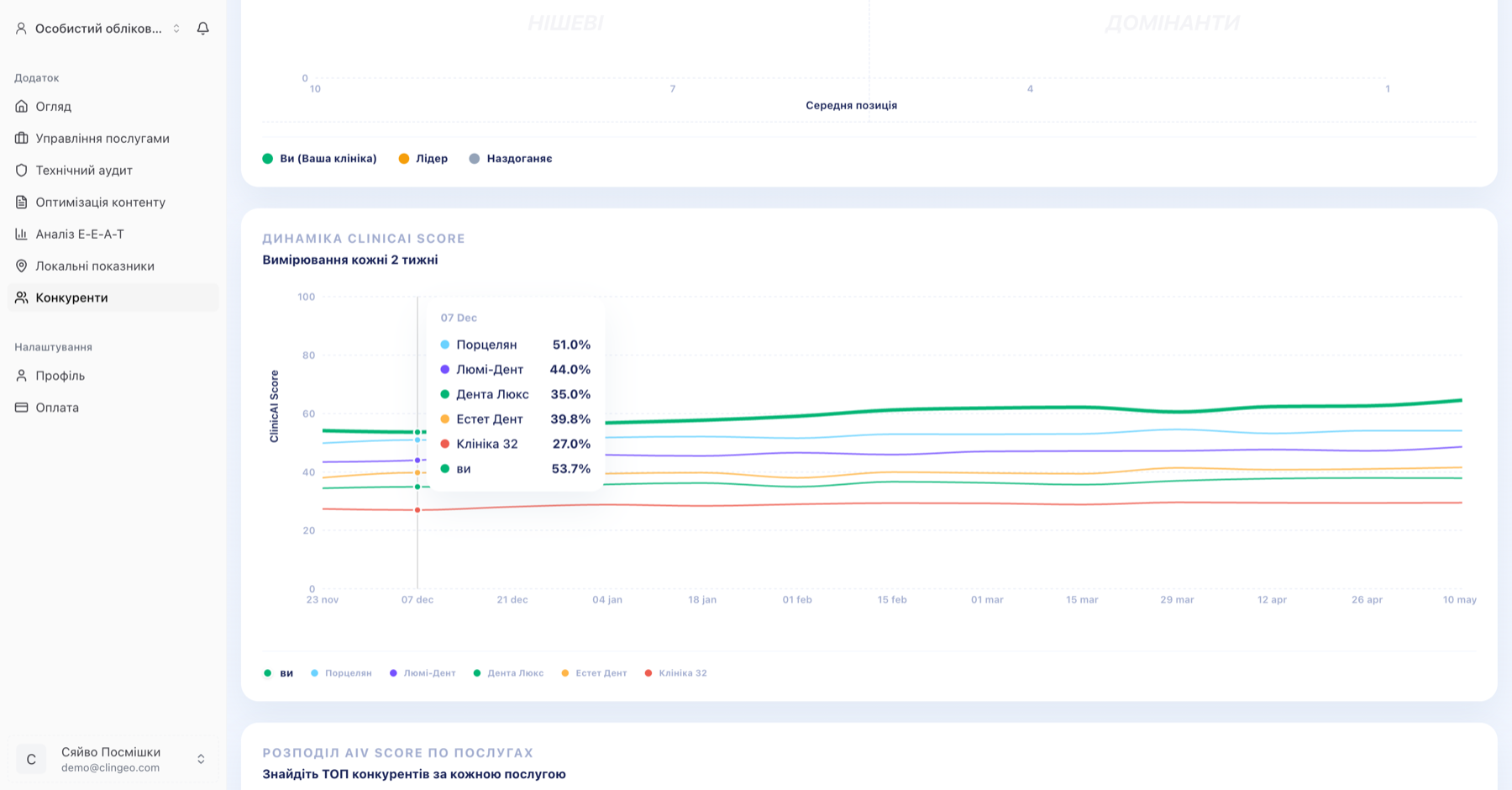
ClinicAI Score dynamics
A line chart showing changes in CAI score for your clinic and top competitors over time. Measurements every 2 weeks — see who's growing and who's stagnating.
Competitor detail card
Click on a competitor to open their detail card:
AI presence by service
A table showing which services the competitor appears for in AI responses. For each service:
- Whether the competitor is visible
- Position in the AI response
AIV comparison
A chart comparing your clinic's AIV against the competitor's over time.
Understanding the competitive landscape
Types of competitors
Common competitor types you'll encounter:
| Type | Examples | Characteristics |
|---|---|---|
| Direct competitors | Other same-specialty clinics in your city | Competing for the same patients |
| Aggregators | Health directories, booking platforms | Have their own service pages, often outrank individual clinics in AI |
| Clinic networks | Large multi-location chains | Advantage through brand recognition and scale |
Tip: If aggregators (health directories, booking platforms) regularly appear in AI responses, make sure your clinic is well-represented on those platforms — complete profile, current services, reviews.
What to do with competitor information?
- Study competitors with AIV > yours — look at their sites and find what they do better (llms.txt, schema, reviews)
- Track trends — if a competitor's AIV spikes, they probably ran optimization
- Check gaps — which services competitors appear for but you don't
Filtering and sorting
The competitors page has filters:
- By service — show competitors for a selected service only
- Sort by — AIV, appearance frequency, alphabetical
Automatic sync
The competitor list requires no manual management — ClinGEO updates it automatically:
- After each AI scan cycle — new domains from responses are added to the list
- Daily at 00:00 UTC — new AIV scores and snapshots are calculated for the comparison chart
Frequently asked questions
Can I remove a competitor from the list?
Competitors are identified automatically based on AI data. If a competitor no longer appears in AI responses over several scan cycles, they automatically lose relevance in the list.
Why are aggregators in the list, not just clinics?
AI systems recommend aggregators alongside individual clinics. This is the real competitive landscape in the AI space, and it's important to account for it.
How many competitors are tracked?
Up to 20 of the most relevant competitors per project.